The following is the net representation of a cube.
How will you place the letters L, A, F on the figure so that it should spell LEAF around the sides of the cube?

Today we have a problem on triangle

Hint:
Since AB=BC, angle C= angle A (Angles opposite to equal sides are equal)
Also, Sum of the angles is 180 º
Answer
55 º
An angle is the union of two non- collinear rays with a common initial point.
Two rays forming an angle are called the 'arms' of the angle and the common initial point is called the 'vertex' of the angle. sometimes, it will be convenient to refer to angle BAC, simply angle A. However this can not be done if there are more than one angle, with the same vertex A.
Interior of an angle: The interior of an angle BAC, is the set of all points P in its plane, which lie on the same side of line AB as C, and also on the same side of line AC as B.
Exterior of an angle: The exterior of an angle BAC is the set of all points Q in its plane, which do not lie on the angle or in its interior.
Types of Angles
An angle whose measure is 90 degrees is called a right angle.
An angle whose measure is less than 90 degree is called an acute angle.
An angle whose measure is more than 90 degrees is called an obtuse angle.
Given a point l and a point P. If P is an element of l,
then we say that P lies on l, or
P is incident on l, or
l passes through P.
Now we can try to find answers to the following questions on the basis of our experience.
- Given a point P, is there a line that passes through P? how many such lines are there?
- Given two distinct points A and B, is there a line that passes through both a and B? How many such lines are there?
- Given a line l, is there a point that lies on it? How many such points are there?
- Given two distinct lines l and m, is there a point that lies on both l and m? how many such points are there?
Based on the results of the above questions we can arrive at the following conclusions. These conclusions have to be taken as axioms.
Incidence Axiom 1: A line contains infinitely many points.
Incidence Axiom 2: Through a given point, there pass infinitely many lines.
Incidence Axiom 3: Given two distinct points A and B, there is one and only one line that contains both the points.
According to the third axiom, any two distinct points of the plane determine a line uniquely and completely.
Definition: Three or more than three points are said to be collinear, if there is a line which contains them all.
Definition: Three or more than three lines are said to be concurrent if there is a point which lies them all.
It is very important for a math student to learn the basic concepts in mathematics. It is a common fact that most children find math is very hard and in particular Geometry. The main reason behind this is that they don't have the basics in maths.
and in Geometry the concepts are more abstract. If the students get some good basic help in math, I am sure most of them do better in maths. So let us learn some basics of Geometry today.
There are three basic concepts of geometry. These are "point", "line" and "plane". I am not attempting to define them as it is not possible to define them precisely. We can however, have a good idea of these three by considering examples. A fine dot made by a sharp pencil on a sheet of paper, resembles a geometrical point very closely. The sharper the pencil, the closer is the dot to the concept of a point.
The surface of a sheet of paper or the surface of a smooth table are examples of plane. But these surfaces limited in extent. The geometrical plane extends endlessly in all directions.
A straight line, drawn on a sheet of paper with a sharp pencil, is a close example of a geometrical straight line. A geometrical line is a set of points and extends endlessly in both the directions. To emphasize this we use two arrowheads.
It is impossible to find exact example for point,line and plane in nature. The geometrical point, line and plane are ideal concepts. but for practical purpose it is enough to deal with close examples.
So, a plane is a set of points, line is a subset of plane. Moreover all the other figures in geometry are sets of points. But they are not just set of points. They are special set of points possessing some properties.
Notation
We use capital letters such as A, B, C, P, Q, R, X, Y, Z etc. to denote points.
We use small letters (lower case) such as l,m,n,p,q,r etc. to denote lines.
Today let’s discuss one problem from geometry.
I‘ll ask you one question. What is the area of a right triangle with sides 4cm 5cm and 9cm? Before trying to answer, please read the question once more.
Answer
It is not possible to make a triangle with the given measurements.
In a triangle, the sum of the two sides will be greater than the third side. Here in this case sum of two sides 4cm+5cm=9cm, which is not greater than the third side of measurement 9cm.
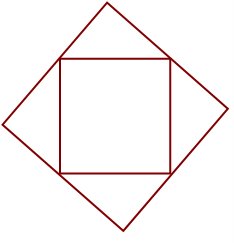
Can you make 2 squares and 4 right triangles using only 8 straight lines?
Answer: