The notion of limit is one of the most basic and powerful concepts in all of mathematics. Differentiation and Integration, which comprise the core of study in calculus, are both products of the limit. The concept of limit is the foundation stone of calculus and as such is the basis of all that follows it. It is extremely important that you get a good understanding of the notion of limit of a function if you have a desire to fully understand calculus at the entry level.
You can find some basic results on limits here
We have four ways to alter the graph of a function: vertical translation, vertical scaling, horizontal translation, and horizontal scaling. Note that some or all four of these can be applied to a function at once in the sense that you may have to deal with a function of the form y = AsinB(x - C) + D. You should simply work these graphs out one step at a time, concerning yourself first with the affect of B and C, then the affect of the presence of A, and finally the affect of D.
Example:
Draw the graph of y =2 sin(x/2+π/6)+3
Solution
Let’s change this is of the form y = AsinB(x - C) + D
So y =2 sin(x/2+π/6)+3
can be written as y =2 sin ½ [x-(-π/3)]+3
Step 1: Draw sinx

B= ½ .so period is 4pi. That means it completes one cycle after 4pi.so stretch the graph horizontally so that its period is 4pi.
Next, we see that C=-pi/3. This will horizontally shift our graph pi/3units to the left. Thus, we now have
Now A=2, which will vertically scale our graph by a factor of 2. Thus, at this point, our range should now be [-2,2]
Finally, we must shift our graph vertically 3 units due to the presence of D=3. Hence, our range will now move to [1,5]
We can adopt the same method for drawing the graphs of other trigonometric functions. But remember first you should convert the given functions of the form
y = A sinB(x - C) + D
y = A cosB(x - C) + D
y = A tanB(x - C) + D
or accordingly, depending upon which of the trigonometric function is given.
The phase shift is the horizontal shift away from the standard graph of the trigonometric function.
In y = AsinB(x - C) + D,C is the phase shift.
For cosine function y = AcosB(x - C) + D and tangent function y = AtanB(x - C) + D also C is the phase shift.
If the phase shift is positive, there has been a horizontal shift to the right and if it is negative, there has been a horizontal shift to the left.
In reading off the phase shift, make sure you have the function in the form above.
For example, the phase shift of y = sin(2x - π /2) is not π/2. Rewrite the expression for the function in the required form to get
y = sin2(x - π/4).
Now we see the correct phase shift, is π/4.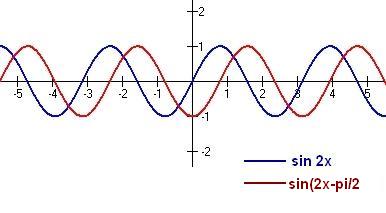
In the graph we can see graph of sin(2x - π /2) is shifted to π/4 units to the right.
We know trigonometric functions are periodic functions. Sinx and cos x are periodic functions with period 2π or 360° . But tan and cot remain unchanged when x is increased by π or 180° .
So, they are periodic functions with period π.
The general form of the sine function is y = A sinB(x - C) + D
Here, the period is 2π/IBI.
The general form of the cosine function is y = A cosB(x - C) + D
We know cosine functions are identical to the sine functions. So, the period of cosine function is also 2π/IBI.
But for a tangent function. It is π instead of 2π because the period of tan x is π.
If the general form of a tangent function is y = A tanB(x - C)+ D,
its period is π/IBI
There fore, the value of B is the key factor in determining the period of tangent functions. Change in its value changes horizontal stretching. When drawing the graph we have to “stretch” or ;“shrink” the graph horizontally by a factor of B.
Also, the period is unchanged by vertical scaling or shifting or by horizontal shifting.
Periodic functions are functions that repeat its values over and over, after some definite period or cycle on a specific period. This can be expressed mathematically that A function f is said to be periodic if there exists a real T>0 such that f (x+T) = f(x) for all x.
The fundamental period of a function is the length of a smallest continuous portion of the domain over which the function completes a cycle. That is, it's the smallest length of domain that if you took the function over that length and made an infinite number of copies of it, and laid them end to end, you would have the original function.
If a function is periodic, then the smallest t>0 ,if it exists such that f (x+t) = f(x) for all x, is called the fundamental period of the function.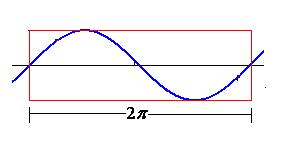
The trigonometric functions sine and cosine are common periodic functions, with period 2π.
ie. sin (x+2π)= sin x , cos(x+2π)=cos x
But tan and cot remain unchanged when x is increased by pi.
ie. tan(x+π)=tan x, cot(x+π)= cot x
So, they are periodic functions with period π .
An aperiodic function (non-periodic function) is one that has no such period
We know basic trigonometric functions are sinx, cosx, tanx.
These functions are periodic functions.( The period is the shortest interval over which the function runs through one complete cycle of its graph.)
Sinx and cos x are periodic functions with period 2π.
But tan and cot remain unchanged when x is increased by pi.So, they are periodic functions with period π.
Amplitude
See the graph of sinx . We know its range is [-1, 1].
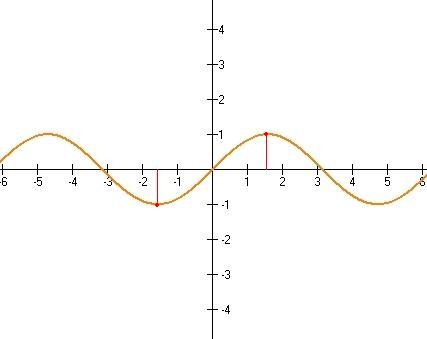
It is clear from the graph that its amplitude is 1
When we draw the graph of 2 sin x, we can see that its range is [-2, 2]
The multiplication factor 2 has “stretched'' the graph of sinx vertically by a factor of 2, while retaining the same x-intercepts.
This vertical scaling factor is known as the amplitude of the function.
The amplitude of the sine and cosine functions is half the vertical distance between its minimum value and its maximum value.
For a function A sin x, its y values range from –A to +A
So amplitude is 1/2 of [A-(-A) ]=A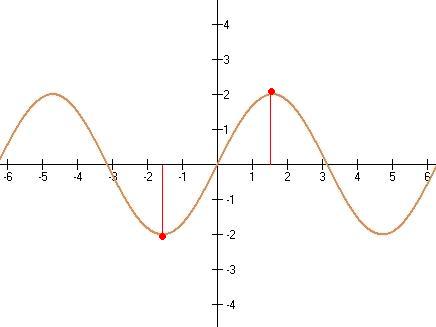
The vertical shifts do alter the greatest and least values that the function attains but do not alter the amplitude.
We can verify this by taking the examples 2sin x and 2sinx+3 For 2sinx,the minimum and maximum values are -2 and 2 .
Amplitude is ½ . 2-(-2)=2
For 2sinx +3, minimum and maximum values are 1 and 5 .
Amplitude is ½ (5-1)=2

In general , the amplitude of
y = A sinB(x - C) + D and
y = A cosB(x - C) + D ,where B is a non-zero real number, is IAI
The tangent function has no amplitude, because the tangent function has no minimum or maximum value.its range is (-infinity, infinity)
Let f:A-->B be a function. Let y0 be an element in B. then y0 is called a value of f provided there is some element, x0 in A, such that y0 = f(x0); that is, y0 is a value of
the function f if it corresponds, with respect to the rule of f, to some x0 in the set A = Dom(f).
Example
Find the value of the following function when x=-2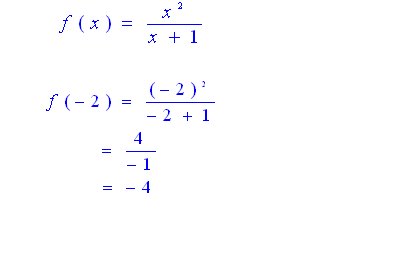
Find the Domain and Range of this function.
Yesterday we have learned what is a function.
Today let's discuss about range and domain of a function.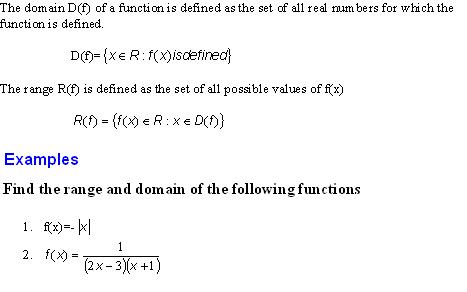
Answers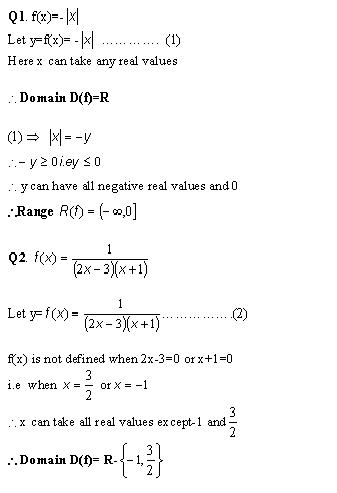
Try to do more problems from your text.

